
Optimizing for Google’s BERT Algorithm: A Comprehensive Guide

In today’s highly competitive digital marketplace, where over half of consumers start their buyer’s journey by searching for products and services on Google, businesses need to ensure their links appear on their search results pages (SERPs) so they can drive targeted organic traffic to their website that they can convert into customers. But Google’s BERT algorithm update in 2019 shifted how Google interpreted search queries. It also significantly impacted 10% of the results displayed on its SERPs.
Considering that there are now over 1 billion active websites on the internet, that’s a lot of businesses that experience a decline in search rankings and organic traffic!
That’s why, in this article, you’ll get a high-level understanding of how BERT works and learn the strategies and best practices to implement in your SEO strategy to improve your website’s rankings on Google’s SERPs.
Understanding Google’s BERT Algorithm
In the past, Google’s algorithm would process and analyze search queries one word at a time.
The problem with this is that Google can’t grasp the context and reason the user has for conducting that search. Because of this, many of the websites displayed on Google’s SERPs didn’t provide the information users were looking for.
With the launch of the BERT (short for Bidirectional Encoder Representations from Transformers) update, Google’s algorithm can now process and analyze words within a search query from left to right and vice-versa.
The BERT algorithm update also enabled Google to focus on specific words within the search query and better understand its context and intent, especially when the query contains prepositions – something Google and other search engines struggled to understand.
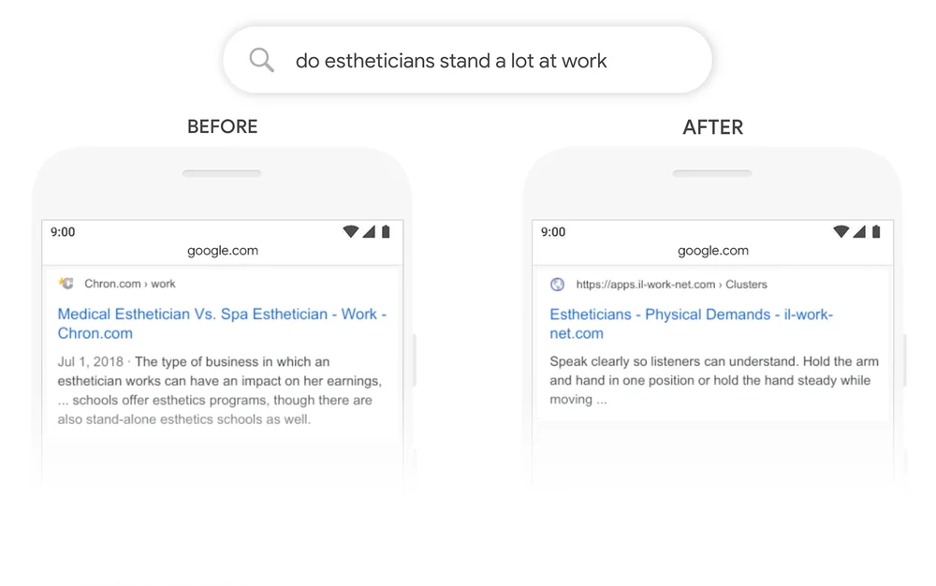
How Google’s algorithm interpreted the search query, “do estheticians stand a lot at work before BERT (left) and after BERT (right).
All these enabled Google to provide users with helpful and relevant content, enhancing their user experience.
The Impact of BERT on SEO
Google’s BERT algorithm update changed the quality and relevance of the search results it provides its users and many of the best practices and optimization techniques used to boost your website’s content search rankings.
In the past, the best way to optimize your content was to repeat your target keywords several times within your content. The more times you can add your target keywords within your content, the more likely it will rank high on SERPs.
Although keywords still play a vital role in SEO, BERT now also considers the quality of the content you publish, especially now that generative AI like ChatGPT has made it possible to churn out a 1,500-word article in minutes quickly.
Since BERT has now made it possible for Google to understand the context of your blog, the content you publish must contain helpful information and insights relevant to the users’ search intent.
Key Strategies to Optimize for BERT
Now that you understand how BERT works and how it’s changed conventional SEO best practices, here are some ways to update your current SEO strategy for BERT.
Focus on Content Quality and Structure
As mentioned, BERT allows Google to understand your target keywords and what’s written on your blog post or article.
One way is using Google’s E-E-A-T principle as a benchmark to evaluate your content to ensure it’s helpful and relevant.
Another is by implementing the Topic Cluster model.
First introduced by HubSpot in 2018, the topic cluster model groups your web content into clusters covering a specific topic.

Topic cluster diagram.
By interlinking related content about a specific topic to each other, you’re providing Google’s users with in-depth information and insights while building internal links, which is still one of the most influential Google ranking factors.
Linking all your content to a specific topic also helps improve your website experience since visitors can quickly find the information they’re looking for, regardless of their device.
Color-coding each category, like in Wrenly’s case, makes it much easier for visitors to find content on a specific topic.

Utilize Targeted Long-Tail Keywords for On-Page Optimization
BERT prioritizes long-tail keywords because they are more specific in intent and the target audience than root keywords.
That said, when conducting keyword research, make sure that you choose keywords that are as specific as possible based on your target audience.
Although these have a significantly lower volume, the traffic is more targeted, making them more likely to convert into customers.
Using a tool like Ahrefs or Semrush can help you find these targeted long-tail keywords to optimize your content.
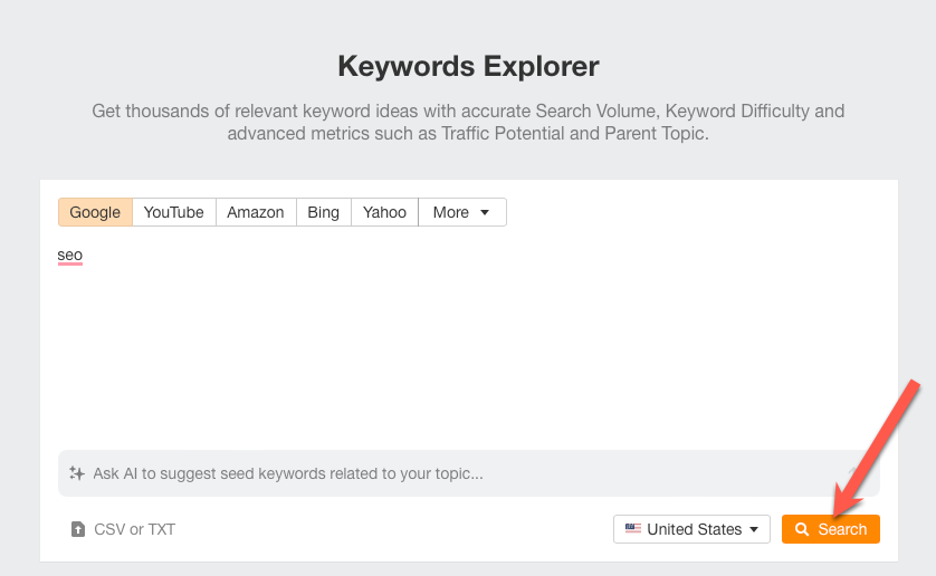
Start by typing the root keyword you want to target in the Keyword Explorer and then click on the Search button.
On the next screen, click on the View All link under Keyword Ideas > Questions.

This will provide you with a list of targeted long-tail keywords that you can use to optimize your content.

Ideally, you’d want to choose long-tail keywords with a reasonably high traffic volume and medium difficulty level. In the case of Ahrefs, that would be a keyword difficulty level between 30 and 79.
Optimize for Voice Search
Voice search has been on the rise in recent years.
This shouldn’t come as a surprise.
After all, it’s much easier to say something than to type it, especially on a mobile device, so you must ensure your content is optimized for voice search.
One way to do this is by writing your article headline and subheadings as a question.
The reason is simple: People ask questions when they use voice search.
More importantly, writing your headlines and subheadings as a question increases the chances of your content being included as a featured snippet on Google’s SERP.

This puts your content at the top of Google’s SERP, increasing your content’s visibility to your target audience.
Another way to optimize your content is by using schema markups.
Schema markup is structured data that tells Google search bots specific details about your website’s content and structure in a way it quickly understands.
This ensures that Google and other search engines can easily crawl and index your content so it gets displayed on their SERPs for relevant searches.
Monitoring and Adapting to BERT
One unique characteristic of BERT is that it continuously trains and improves with every search query it processes.
The rise of generative AI will only make BERT smarter and evolve even faster.
It also means that you must be extra vigilant in monitoring the results so your SEO strategy remains resilient in this ever-evolving landscape.
Tools like Google Analytics monitor your website’s search performance. At the same time, Google Search Console will notify you if you need to make any changes to your technical SEO, especially after Google releases another algorithm update.
On the other hand, platforms like Quora can give you better insights into what types of questions your target audience is asking and, more importantly, how they’re framing their questions.
You can then use this information to create fresh content to publish on your website and optimize it in a way BERT prefers.
Conclusion
Google’s BERT algorithm update completely turned traditional SEO best practices on its head. With generative AI slowly entering the picture and the frequency of Google’s algorithm updates, it’s understandable for even seasoned SEO professionals to feel like they’re starting all over.
The tips and strategies in this article will help you get a better footing in developing and implementing an SEO strategy for the BERT era.
Still, this is not the time to take things easy.
The SEO realm is evolving rapidly. Staying updated on the latest SEO and generative AI trends is necessary to ensure you’re agile enough to adapt quickly to the changes to improve search rankings further and drive targeted organic traffic to your website.
